
Are They Thinking, or Just Navigating?
When answers became easier to find, did thinking become easier to avoid?
6/12/20265 min read
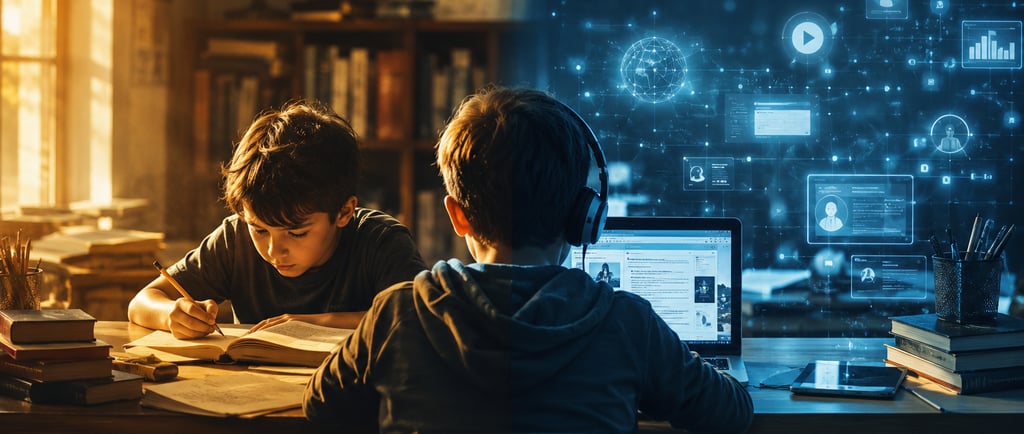
There was a time when education asked something difficult from us. It asked us to sit still with a question. It asked us to remember. It asked us to struggle a little before understanding arrived. It asked us to stare at a blank page long enough for our own thoughts to appear.
That struggle was not always pleasant. Sometimes it was boring. Sometimes it was frustrating. Sometimes it made us feel stupid for a while. But there was something important inside that discomfort. It made the mind work.
Today, that discomfort has not disappeared completely. But it has been softened, shortened, outsourced, and sometimes treated as unnecessary.
A student does not have to sit with a question for long anymore. A search result is waiting. A video is waiting. A summary is waiting. A tool is ready to explain, rewrite, organize, calculate, and present.
On one hand, that is powerful. Technology has opened doors education could never open before. A child with limited resources can access lessons from anywhere in the world. A student who struggles with reading can listen. A visual learner can see what a textbook could not show. A child who once felt left behind can find another way in.
So this is not an argument against technology. That would be unrealistic. And honestly, unfair.
The world is moving forward. Computers are already part of the future. Artificial intelligence, tablets, digital classrooms, online learning, and smart tools are not temporary visitors. They are here. They will grow. They will shape how we work, communicate, and learn.
But maybe the question is not whether technology belongs in education. Maybe the deeper question is this:
Are we using technology to support learning, or are we redesigning learning to suit technology?
Because somewhere along the way, education seems to have bent. Not all at once. Not loudly. But slowly.
We brought devices into classrooms. Then we changed the way lessons were delivered. Then we changed the way students completed work. Then we changed the way tests were taken. Then we changed what we expected students to know, remember, and produce on their own.
At first, each change made sense. Open book tests made sense. Online assessments made sense. Digital submissions made sense. AI assisted workflows made sense.
But when we step back, the bigger picture becomes harder to ignore. The system is adjusting its expectations around the tool. And that should make us pause.
Because education was never only about reaching an answer. It was about what happens to the mind on the way there. The confusion. The effort. The false starts. The quiet excitement when something finally clicks. The pride of understanding something because you wrestled with it yourself.
That process matters. A child who builds an answer slowly owns it differently from a child who simply finds it quickly. There is a difference between knowing where the answer is and knowing how to think toward it.
And this is where I worry. Not because children today are weak. I do not believe that.
It is too easy to blame younger generations and say they are lazy, distracted, or incapable of focus. That is not fair. They are growing up in a world we built for them.
They were born into speed. They were raised around instant answers. They learned in environments where information was never far away. Their attention was not simply divided. It was trained by the world around them to move quickly from one thing to another.
So of course their minds adapted. They learned to scan. They learned to retrieve. They learned to switch. They learned to find answers fast.
These are not failures. They are survival skills in a fast world.
But every adaptation has a cost. When we become good at scanning, we may become weaker at staying. When answers arrive too quickly, we may lose the habit of building them. When tools are always present, we may forget what our own thinking feels like without assistance.
And if education simply follows that pattern, instead of balancing it, then school stops being a place that strengthens the mind. It becomes a place that teaches students how to move efficiently through systems.
Click. Search. Copy. Paste. Submit. Done.
But learning should not feel only transactional. Input. Output. Result.
A human mind is not a machine waiting for faster processing. A child is not an unfinished worker who needs early training for productivity. A classroom is not meant to become a small office.
Especially in the early years, children need more than screens. They need paper. Mud. Pencils. Books. Arguments. Waiting. Listening. Falling. Getting up. Building something with their hands. Watching it collapse. Trying again.
They need boredom too. Not the cruel kind. The useful kind. The kind where imagination slowly wakes up because nothing else is entertaining it. The kind where a child looks around, wonders, touches, asks, notices, and creates.
A screen can show a child the world. But it cannot replace the feeling of being in the world.
It cannot replace the weight of a pencil in the hand. It cannot replace the patience built from forming letters slowly. It cannot replace the lesson learned from falling on the ground and realizing the body is stronger than fear.
It cannot replace the strange little wisdom children collect when they play outside, get dirty, negotiate with other children, lose a game, cry, forgive, and start again.
Those are not distractions from education. Those are education.
The problem is not that technology exists. The problem begins when convenience becomes the highest value.
When faster becomes better. When easier becomes smarter. When assisted work is mistaken for deeper understanding. When the system quietly asks, “How can we make this smoother?” but forgets to ask, “What strength might be lost if this becomes too smooth?”
Because some resistance is necessary. Muscles do not grow without resistance. Character does not grow without challenge. And thinking does not deepen when every difficult moment is immediately rescued by a tool.
This does not mean we should throw away technology and return to chalkboards as if the past was perfect. The past had its own problems. Education was not magical simply because it was harder. Many students were left behind. Many different kinds of intelligence were ignored. Many children suffered silently because the system only rewarded one way of learning.
Technology can help correct some of that. But it should not remove the human struggle that makes learning meaningful.
It should not steal the silence where thought forms. It should not replace memory before memory has had a chance to strengthen. It should not give children shortcuts before they have learned the road.
Maybe the future of education needs both. The tool and the mind. The screen and the soil. The search engine and the blank page. The iPad and the scraped knee. The digital skill and the human patience to sit with something difficult.
Because the people who thrive in the future may not be the ones who can access information the fastest. Information will be everywhere. Speed will be everywhere. Tools will be everywhere.
The rare skill will be depth. The rare skill will be attention. The rare skill will be the ability to sit with complexity when there is no easy answer.
And that is something no device can fully do for us.
Technology can open the door. But the mind still has to walk through it.